Resources
Worksheets, templates and reference material
Every document here is generated from the canonical Seven Principles curriculum (version 1.0), so a worksheet you download matches the lesson exactly as it is taught.
Find a worksheet or a term
Filters both the worksheet library and the glossary below.
28 lesson worksheets across seven principles · 84 glossary terms
Workbook and curriculum
Print full editions, or open the editing room behind the curriculum.
Seven Principles Workbook publishing
Participant and facilitator editions, full workbook, pillar booklets, lessons-only or worksheets-only, US Letter or A4.
Open workbook publishingCurriculum studio
The administrator's editing room for the curriculum itself. Change lesson wording, exercises, evidence requirements, rubrics and scoring, then move the version through review to approved and published — every page, worksheet and PDF in this platform re-renders from those edits. Version 1.0.
Open curriculum studioWorksheets and templates by module
The complete set, in module order S1 through S7 and lesson order within each module. Each download is the real worksheet for that lesson: instructions, inputs, the blank grid and the sign-off block.
S1 Build Financial Literacy
Foundation pillar · rolls into Financial Literacy Foundation Plan
Biblical Financial Literacy Definition Worksheet
Lesson 1: What Biblical Financial Literacy Is (and Is Not) · 35 minutes · Pastor, financial ministry leader, small-group coordinator, and two or three lay leaders
Produce a written, approved definition of biblical financial literacy and a guardrail statement the church will use consistently across all teaching settings.
Statement and Budget Reading Competency Check
Lesson 2: Reading the Numbers: Statements, Budgets and Ministry Decisions · 40 minutes · Financial ministry leader, small-group coordinator, treasurer, and a sample group of household volunteers
Diagnose specific gaps in the ability of leaders and sample households to read a financial statement and a monthly budget accurately.
Congregation-Wide Literacy Teaching Plan by Life Stage
Lesson 3: Teaching Financial Literacy Across the Congregation · 40 minutes · Pastor, financial ministry leader, small-group coordinator, and at least two prospective small-group teachers
Design and schedule a recurring financial literacy teaching plan spanning at least four life stages, with named teachers and calendar dates.
Literacy Growth Measurement Plan and Gaps Register
Lesson 4: Measuring Literacy Growth and Closing the Gaps · 40 minutes · Pastor, financial ministry leader, treasurer, small-group coordinator, and one board member
Establish a repeatable measurement plan for literacy growth and consolidate every gap identified across the module into one register with named owners and dates.
S2 Build a Financial Reserve
Foundation pillar · rolls into Operating Reserve Policy and Funding Plan
Reserve Purpose and Mindset Reflection
Lesson 1: Why a Reserve Is Stewardship, Not Hoarding · 30 minutes · Household decision-makers, ideally both spouses or partners if applicable
Build shared, motivated agreement across the household that a reserve is an act of stewardship worth prioritizing, grounded in the household's own past experience.
Essential Monthly Operating Expense Worksheet
Lesson 2: Calculating Essential Monthly Operating Expenses · 45 minutes · Household decision-makers, ideally both spouses or partners if applicable
Produce a verified, category-by-category total of the household's true essential monthly operating expenses to anchor the reserve target calculation.
Reserve Target and Funding Timeline Worksheet
Lesson 3: Setting the Three-to-Six-Month Target and Funding It · 45 minutes · Household decision-makers, ideally both spouses or partners if applicable
Set a specific dollar reserve target within the three-to-six-month range and build a realistic, sustainable monthly funding plan with a clear timeline.
Reserve Governance and Review Charter
Lesson 4: Protecting, Governing and Reviewing the Reserve · 40 minutes · Household decision-makers, ideally both spouses or partners if applicable
Write the withdrawal definition, replenishment rule, review schedule and risk-awareness notes that protect and govern the reserve built in Lessons 2 and 3.
S3 Eliminate High-Cost Liabilities
Foundation pillar · rolls into High-Cost Liability Elimination Plan
Complete Liability Inventory with true annual cost calculated for every debt
Lesson 1: Naming Every Liability and Its True Cost · 40 minutes · Pastor, treasurer, finance committee, and one or two board members
Build a single, verified list of every church liability with its true all-in annual cost as the baseline for the rest of the module.
Payoff Priority Ranking using rate, risk and ministry-impact scoring
Lesson 2: Prioritizing Payoff: Rate, Risk and Ministry Impact · 50 minutes · Pastor, treasurer, finance committee, and a board representative
Rank every liability for payoff priority using a documented method and direct extra payments accordingly.
Refinancing and Renegotiation Comparison Log with a written new-debt approval policy
Lesson 3: Refinancing, Renegotiating and Avoiding New High-Cost Debt · 55 minutes · Pastor, treasurer, finance committee, and legal or financial advisor if available
Benchmark at least one liability against current market terms and adopt a written policy preventing future high-cost borrowing without board comparison and approval.
Congregation Debt-Free Pathway Outline with referral partner list
Lesson 4: A Debt-Free Path for the Congregation · 55 minutes · Pastor, discipleship or stewardship ministry lead, pastoral care lead, and one board member
Design a recurring, product-neutral debt-free teaching pathway and a vetted referral partner list for households carrying high-cost debt.
S4 Cultivate Generosity Through Giving
Generosity pillar · rolls into Generosity Formation and Giving Health Plan
Discipleship-First Generosity Philosophy Statement
Lesson 1: Generosity as Discipleship, Not Fundraising · 40 minutes · Pastor, teaching team, generosity ministry lead, and one or two board members
Classify a year of giving communications as teaching, invitation or appeal, and draft a written philosophy that commits the church to a discipleship-first posture.
Aggregate Giving Health Reading and Household-Privacy Protocol
Lesson 2: Reading Giving Health Without Exposing Households · 40 minutes · Pastor, treasurer, generosity ministry lead, and one or two board members
Calculate this year's aggregate giving health metrics and adopt a written protocol restricting individual giving-record access to narrow, named purposes.
Twelve-Month Generosity Calendar
Lesson 3: Teaching, Inviting and Thanking: The Generosity Calendar · 40 minutes · Pastor, teaching team, generosity ministry lead, communications lead, and one or two board members
Map, rebalance and assign ownership for a full year of teaching, inviting and thanking moments consistent with the church's generosity philosophy.
Transparency and Reporting-Back Plan with a draft congregational report
Lesson 4: Transparency, Trust and Reporting Back to Givers · 40 minutes · Pastor, treasurer, communications lead, generosity ministry lead, and one or two board members
Draft a recurring, plain-language transparency report connecting aggregate giving to specific ministry outcomes, checked against the household-privacy protocol.
S5 Invest in Future Ministry
Provision pillar · rolls into Future Ministry Investment Plan
Ten-Year Capacity and Calling Vision Map
Lesson 1: Seeing Ten Years Ahead: Capacity, Facilities and Calling · 45 minutes · Pastor, facilities lead, a technology-minded leader, and one or two board members
Produce a written, prioritized ten-year vision for facilities, technology, staffing and program capacity with order-of-magnitude cost estimates for the largest gaps.
Future Ministry Fund Charter and Funding Formula
Lesson 2: Building the Future Ministry Fund · 50 minutes · Pastor, treasurer, finance committee, and the facilities or capacity-planning lead from Lesson 1
Adopt a written charter and funding formula for the Future Ministry Fund, tested against real historical financial results and the priority gaps named in Lesson 1.
Investment Policy Statement Draft
Lesson 3: Prudent Stewardship of Long-Horizon Funds · 50 minutes · Pastor, treasurer, finance committee chair, and, where available, an advisory-only licensed professional congregation member
Draft a written, product-neutral investment policy statement for the Future Ministry Fund covering time horizon, risk tolerance, diversification, cost review, prohibited practices and qualified-advisor engagement.
Decision, Approval and Review Framework
Lesson 4: Deciding, Approving and Reviewing Investments in Ministry · 50 minutes · Full board or governing body, pastor, treasurer, and the leads from Lessons 1 through 3
Adopt a written, tiered decision framework with a standard proposal template and a mandatory post-implementation review schedule for future-ministry investments.
S6 Provide for Your Pastors' Wellbeing
Provision pillar · rolls into Pastoral Wellbeing and Compensation Plan
Current-State Honesty Assessment
Lesson 1: The Biblical and Practical Case for Caring for Those Who Serve · 35 minutes · Board chair, personnel or compensation committee, and one additional elder or trustee
Establish an honest, documented baseline of current pastoral care practice across five indicators, and formally assign governance ownership going forward.
Compensation Philosophy Statement and Benchmarked Salary Range Worksheet
Lesson 2: Building a Fair, Documented Compensation Framework · 45 minutes · Personnel or compensation committee, board chair, and treasurer
Draft a written compensation philosophy and build a benchmarked salary range to evaluate current pastoral pay and plan any needed adjustment.
Benefits, Retirement and Risk-Protection Review Checklist
Lesson 3: Benefits, Retirement and Risk Protection for Pastoral Families · 45 minutes · Personnel or compensation committee, treasurer, and pastor if willing to participate at the policy level
Document current benefits and retirement provisions against benchmark practice, and complete a policy-level risk-protection review with referrals for any identified gap.
Rest and Renewal Policy Draft with Pastoral Coverage Plan
Lesson 4: Rest, Renewal and Longevity in Ministry · 40 minutes · Personnel or compensation committee, board chair, and pastor
Draft a written weekly sabbath, vacation and sabbatical policy paired with a concrete pastoral-coverage plan, and assemble the completed Pastoral Wellbeing and Compensation Plan for governance approval.
S7 Give Generously
Mission pillar · rolls into Missions and Community Outreach Giving Plan
Community and Mission-Field Profile
Lesson 1: Looking Outward: Naming the Community and the Mission Field · 45 minutes · Pastor, missions or outreach team lead, one or two board members, and a community liaison if one exists
Build a current, sourced, specific picture of community needs and mission-field commitments to ground every later funding and partnership decision.
Missions and Outreach Budget Worksheet
Lesson 2: Funding Missions and Outreach on Purpose · 45 minutes · Pastor, treasurer, missions or outreach team lead, and finance committee
Set a specific missions and outreach dollar figure and allocation, tied to a stated rationale and split between committed and flexible funding.
Partner Vetting and Agreement Tracker
Lesson 3: Partnering Well: Vetting, Agreements and Accountability · 50 minutes · Pastor, missions or outreach team lead, treasurer, and one board member
Document vetting status, agreement status and accountability check-in dates for every current and prospective missions and outreach partner.
Outward Impact Report
Lesson 4: Measuring Outward Impact and Reporting It Honestly · 40 minutes · Pastor, missions or outreach team lead, treasurer, and communications lead if one exists
Compile a verified, honest impact report across all current partners, including at least one named shortfall, and plan how to communicate it to the congregation.
Module reference
Each module, its pillar and its principal deliverable.
| Module | Group | Principal deliverable | Open |
|---|---|---|---|
| S1 Build Financial Literacy | Foundation | Financial Literacy Foundation Plan | Open |
| S2 Build a Financial Reserve | Foundation | Operating Reserve Policy and Funding Plan | Open |
| S3 Eliminate High-Cost Liabilities | Foundation | High-Cost Liability Elimination Plan | Open |
| S4 Cultivate Generosity Through Giving | Generosity | Generosity Formation and Giving Health Plan | Open |
| S5 Invest in Future Ministry | Provision | Future Ministry Investment Plan | Open |
| S6 Provide for Your Pastors' Wellbeing | Provision | Pastoral Wellbeing and Compensation Plan | Open |
| S7 Give Generously | Mission | Missions and Community Outreach Giving Plan | Open |
The three Nsites applications
The Seven Principles curriculum names the questions. These three applications supply the evidence. Perception, evidence and execution stay separate — nothing here is blended into a single Seven Principles score.
Stewardship Nsites
Leadership, finance team and board
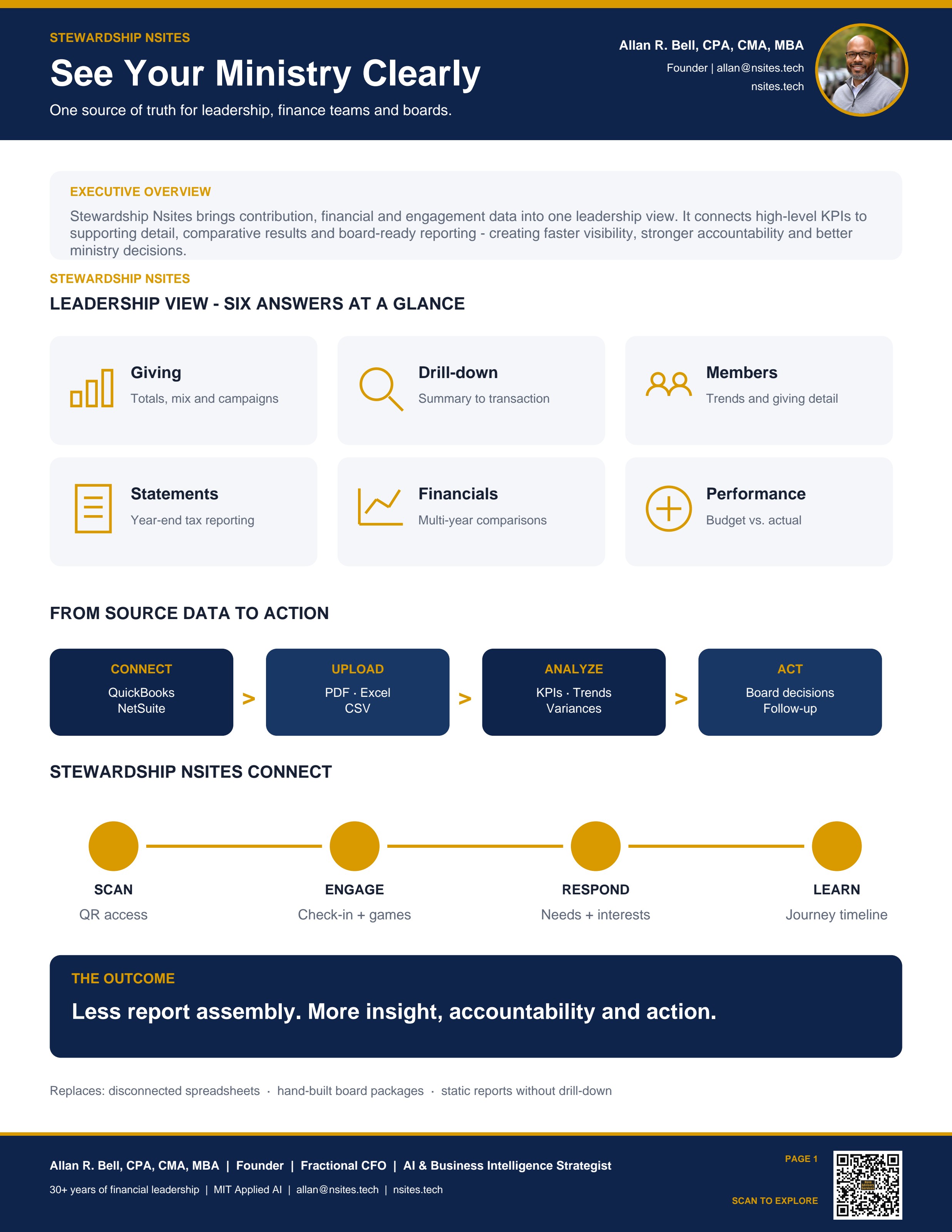
Brings contribution, financial and engagement data into one leadership view, from high-level KPIs down to the transaction that produced them.
Evidence it contributes: Giving totals and mix, budget versus actual, operating runway, giver concentration, digital adoption, multi-year comparisons and board-ready reporting.
Open Stewardship NsitesStewardship Nsites Connect
Members and guests, on their phones
Scan-to-check-in, engagement games, needs and interest responses and a journey timeline, so connection is recorded as it happens rather than guessed at later.
Evidence it contributes: Attendance and check-in patterns, first-time guest follow-up, small group and serving participation, expressed needs and interests, and connection journey movement.
Open Stewardship Nsites ConnectPersonal Nsites
Individual households, privately
A household's own financial wellness journey: assessment, readiness score, plan, goals, learning library and coaching — owned by the household, not the church.
Evidence it contributes: Aggregate, de-identified household participation and readiness movement only. No individual household financial data ever reaches church leadership.
Open Personal NsitesStewardship Nsites — illustrative examples
Sample pages showing what leadership sees. All figures are illustrative sample data.
Executive overview
How contribution, financial and engagement data come together in one leadership view.
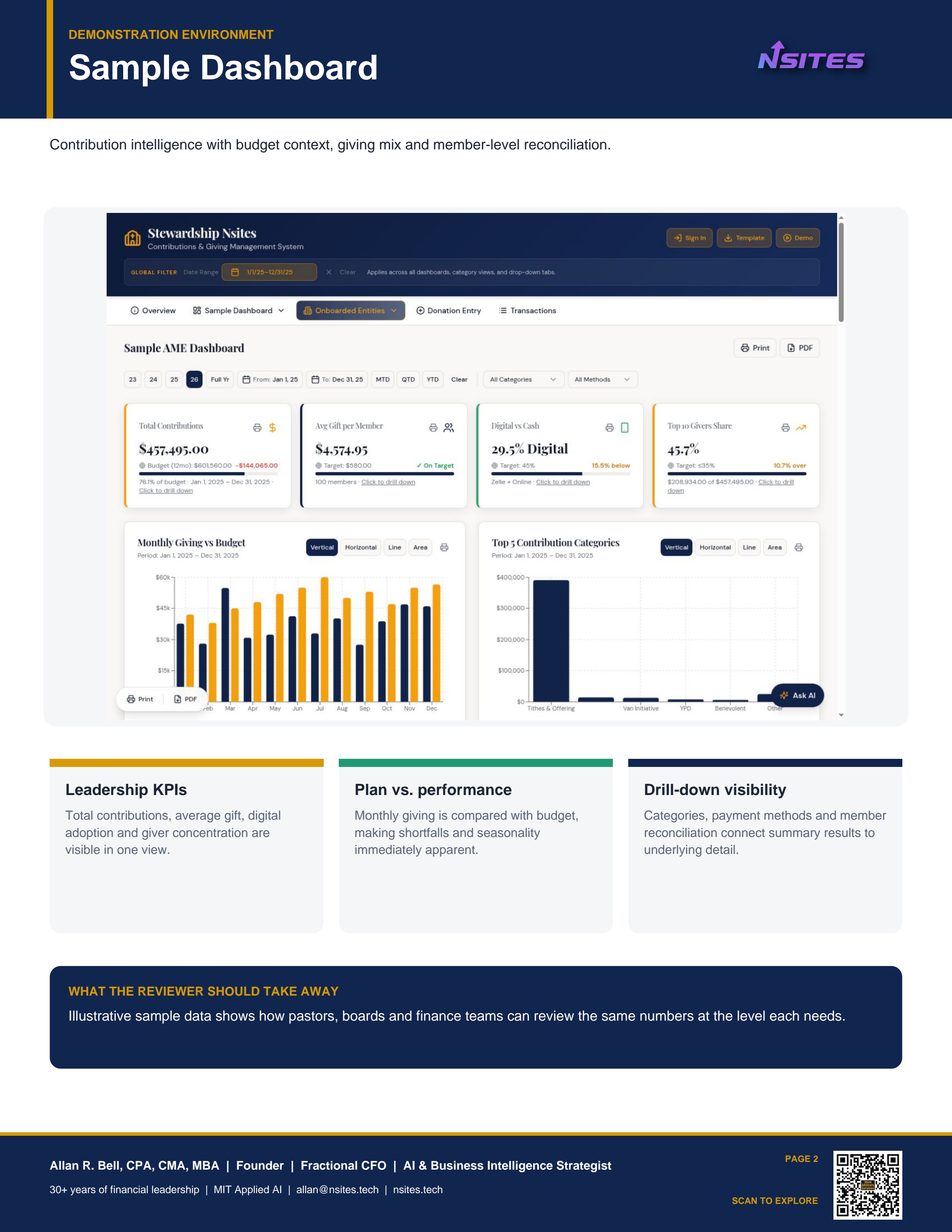
Sample dashboard
Giving totals against budget, giving mix, digital adoption and giver concentration.
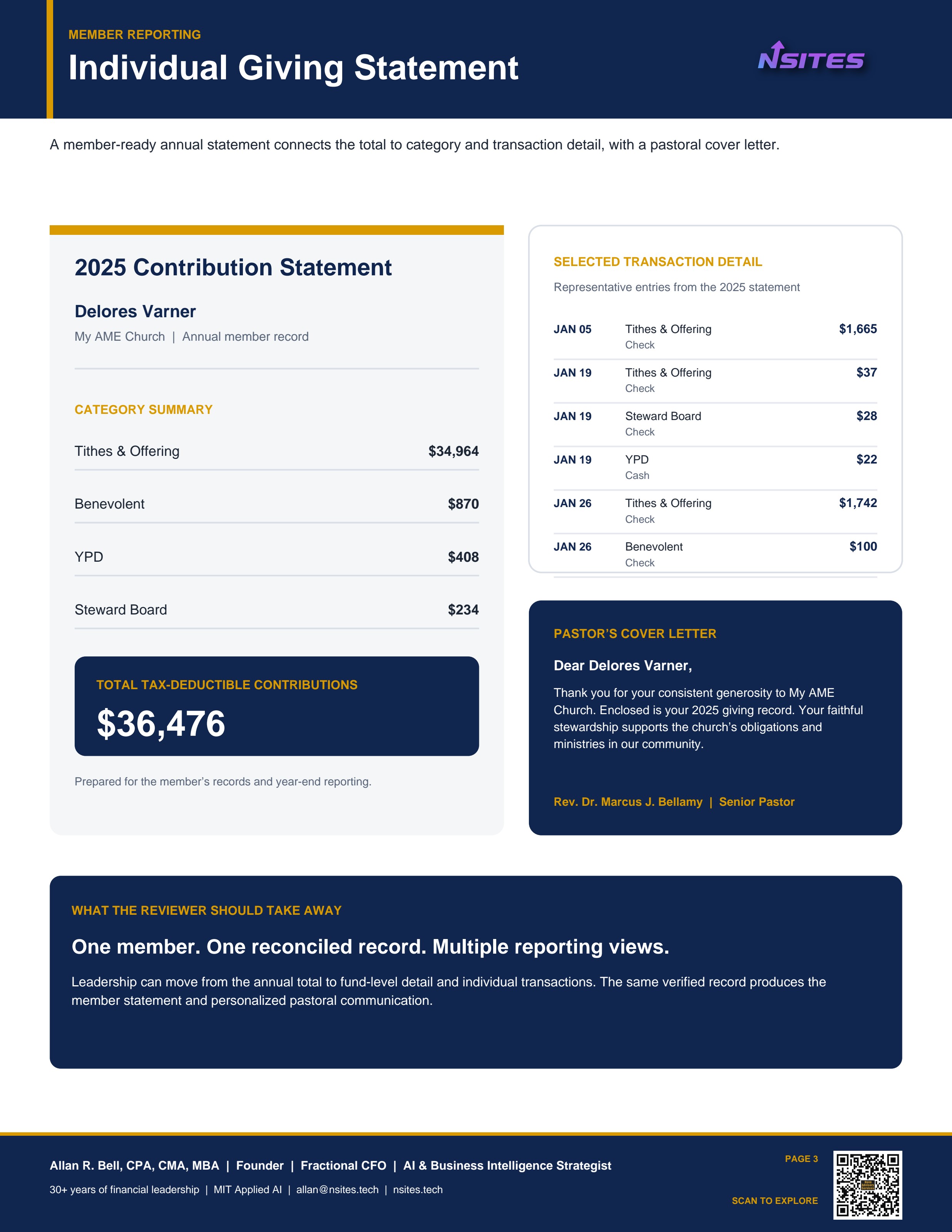
Individual giving statement
A member-ready annual statement with category and transaction detail and a pastoral cover letter.
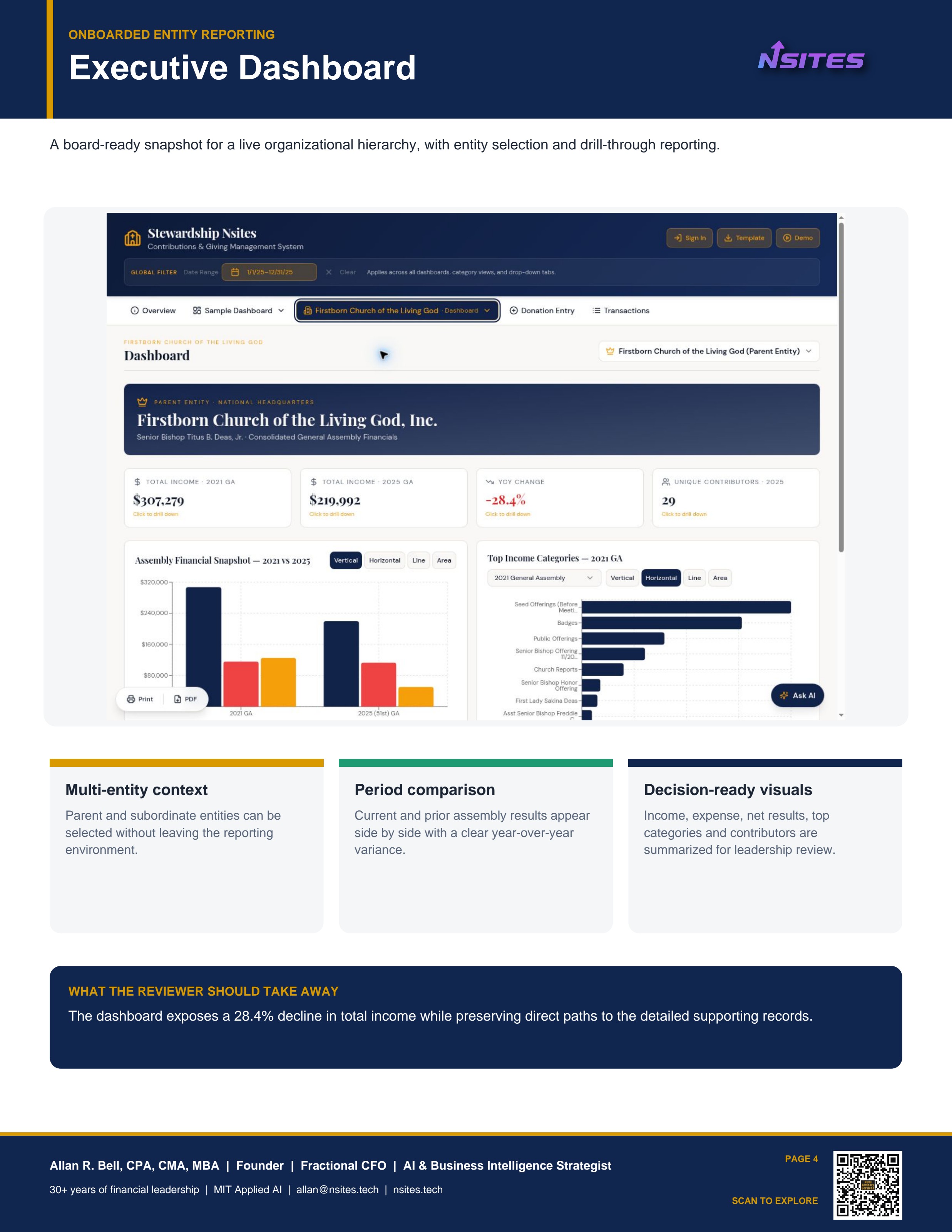
Executive dashboard
Multi-entity selection with period comparison and drill-through to supporting records.
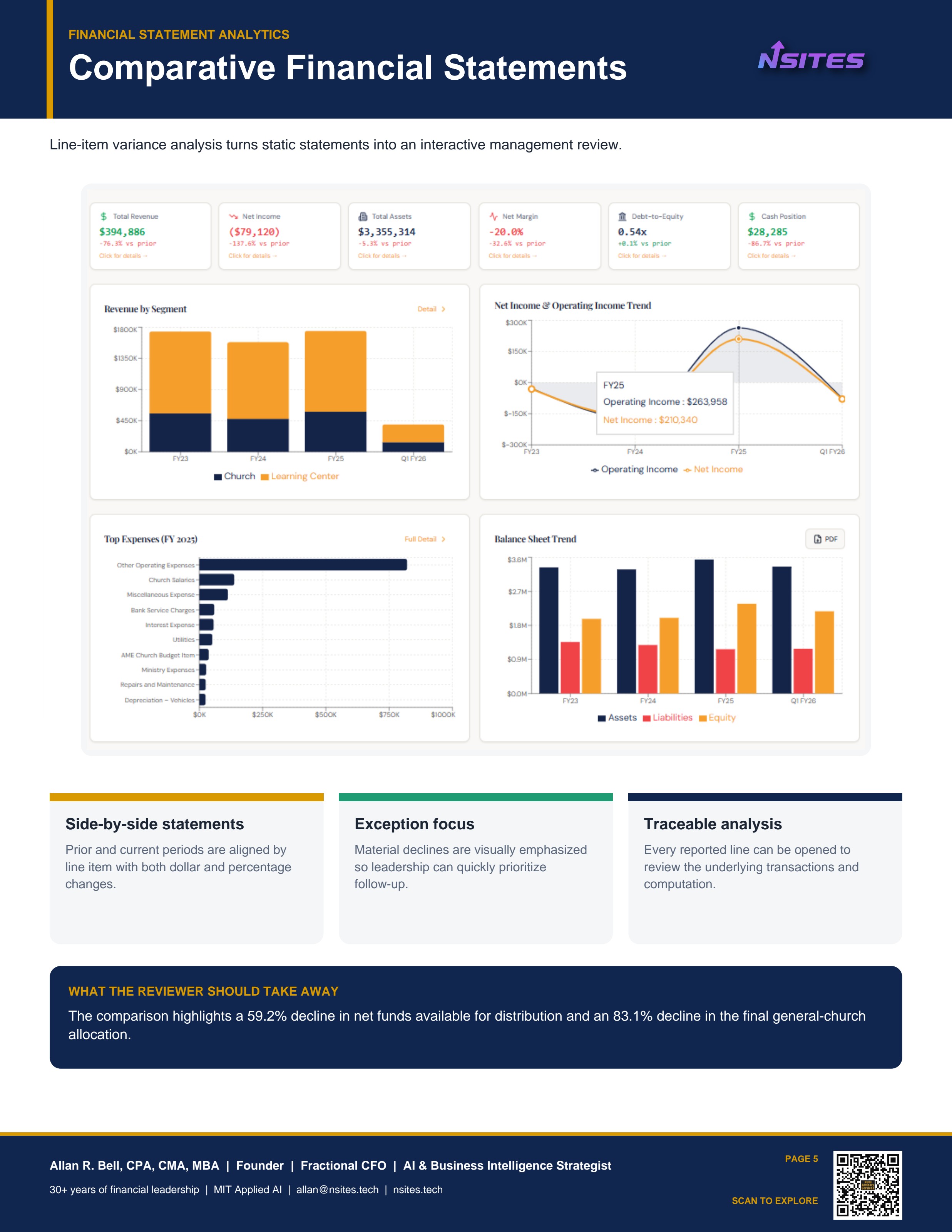
Comparative financial statements
Line-item variance analysis with traceable detail behind every reported line.
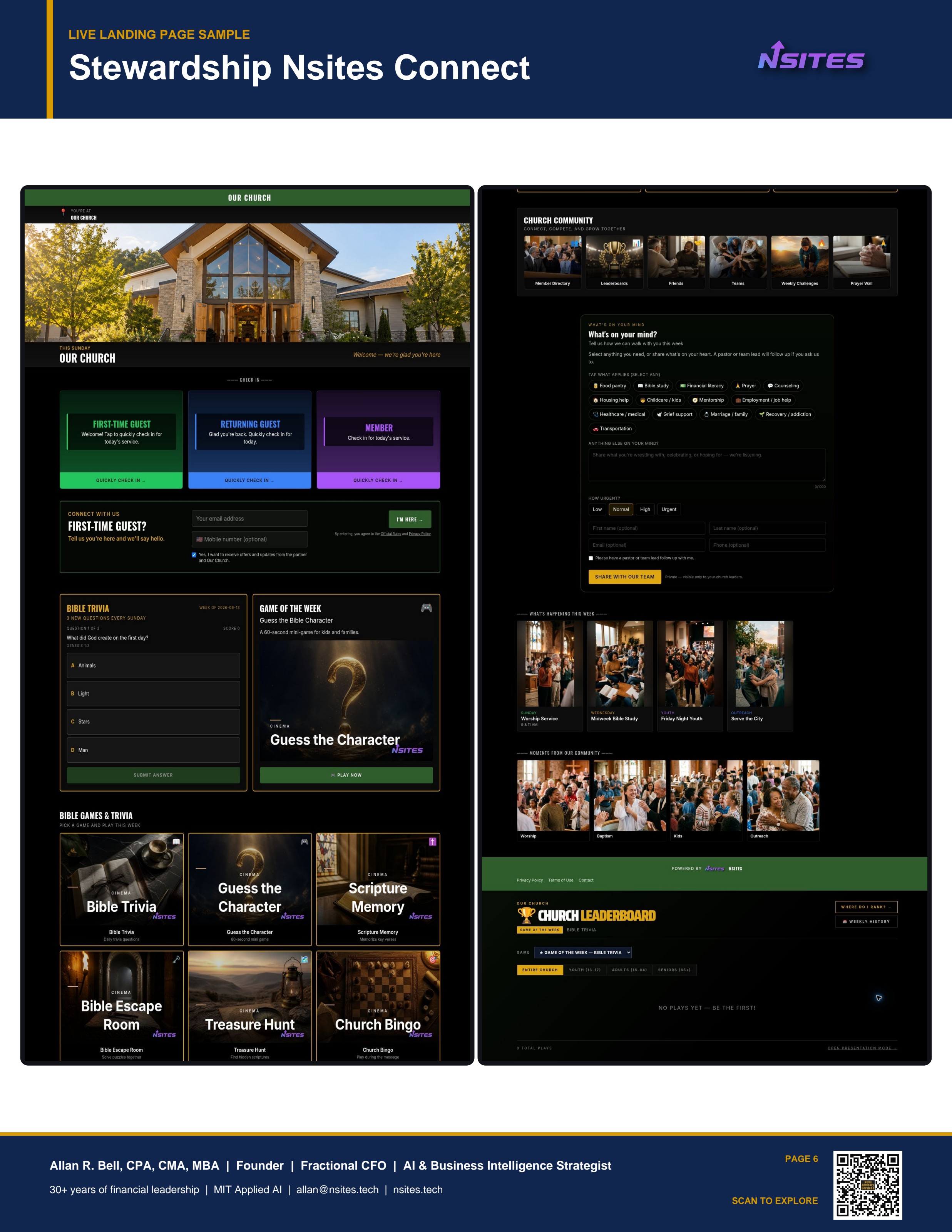
Stewardship Nsites Connect — one-page summary
The reference sheet for Connect: scan to check in, engage, respond with needs and interests, and follow the journey timeline — plus the member directory, teams, weekly challenges, leaderboard and prayer wall.
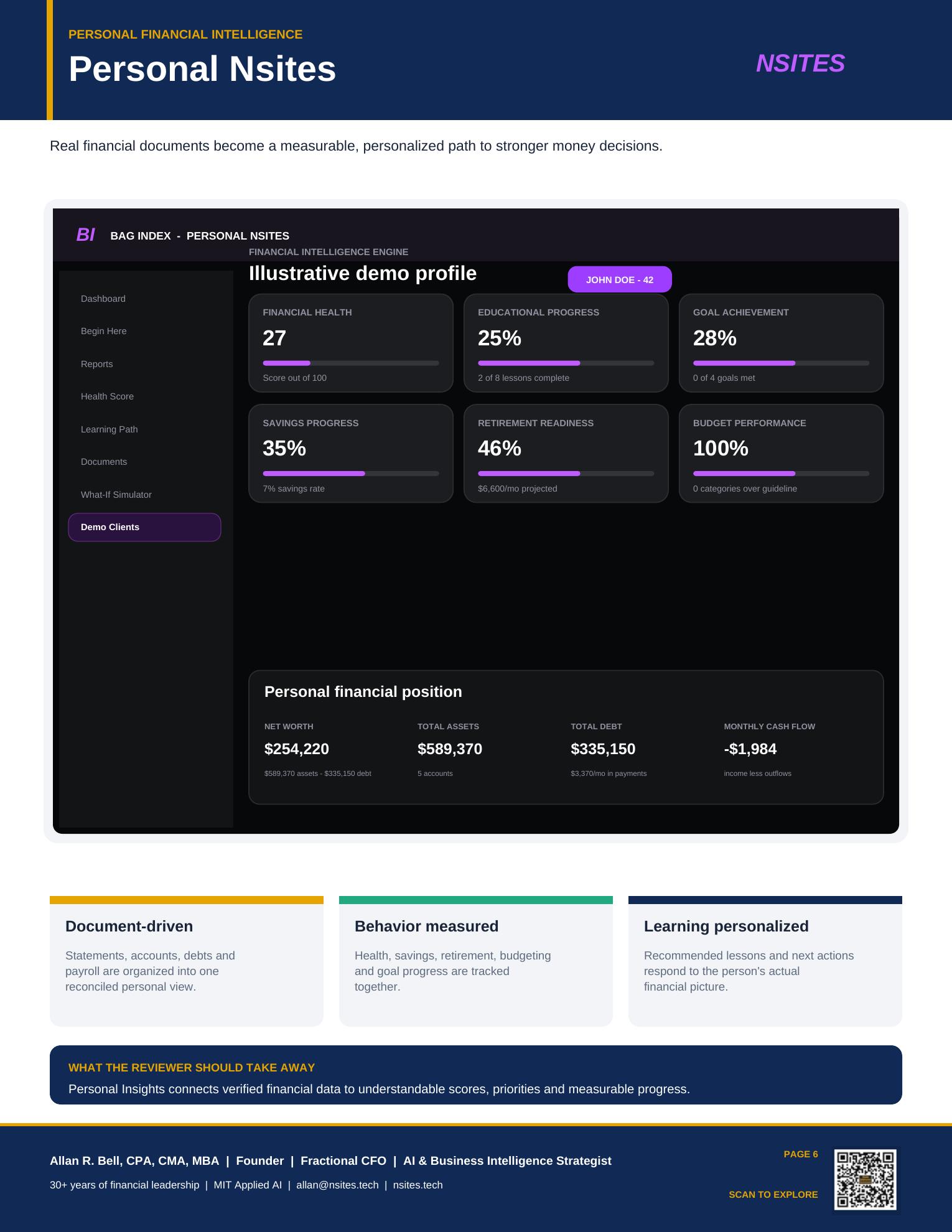
Personal Nsites — illustrative overview
These two pages show the private household experience and how documents become a personal action plan. Church leadership only ever sees aggregate, de-identified participation and movement — never an individual household's finances.
Personal Nsites overview
How real financial documents become a measurable, personalized path to stronger money decisions.
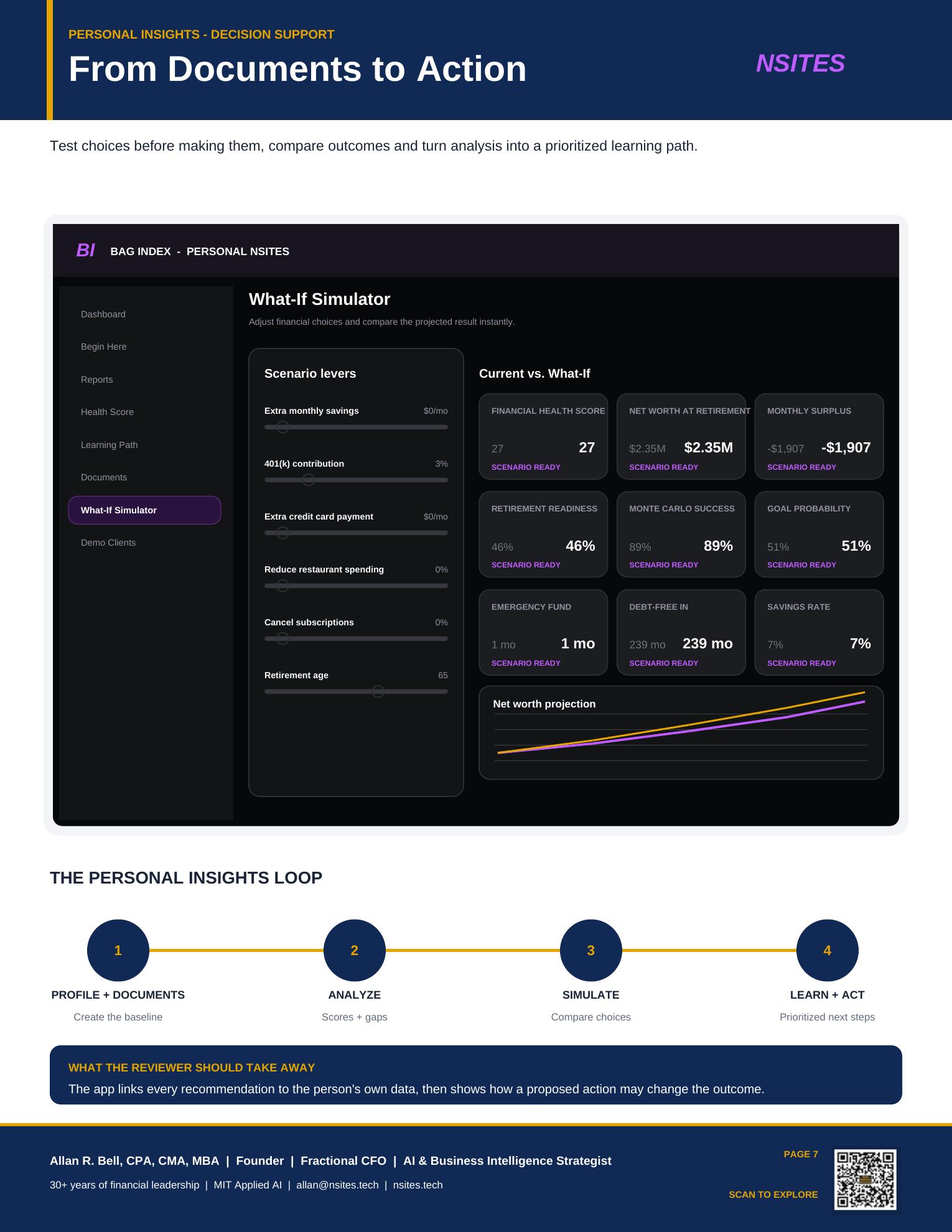
From documents to action
The personal financial loop from private documents through analysis, comparison and an updated plan.
- Financial Wellness Assessment
Where a household establishes its own starting point.
- Readiness Score
The household's own measure of financial readiness over time.
- Personal Financial Plan
Budget, debt, savings and giving capacity in one household plan.
- Learning Library
The teaching households work through between coaching sessions.
Glossary
Every key term taught in the curriculum — 84 terms harvested from all 28 lessons, de-duplicated and listed alphabetically with the modules they come from.
A
- Aggregate reporting
- Sharing results as summarized, deidentified totals or percentages rather than any individual household's specific data.
- S1 · L4
- Approval threshold
- A dollar amount above which a proposed expenditure or investment requires a specified higher level of review or approval.
- S5 · L4
- Automated transfer
- A scheduled, recurring movement of funds from checking into a separate savings account that occurs without requiring a manual decision each month.
- S2 · L3
B
- Benchmark range
- A low, midpoint and high compensation figure drawn from comparable-role data sources, used to evaluate whether current pay is fair relative to the market.
- S6 · L2
- Benefits inventory
- A documented list of all non-salary provisions a church makes for its pastor, including health coverage, retirement contribution and additional allowances.
- S6 · L3
- Biblical financial literacy
- The ability to understand, discuss and act on personal financial information in light of a biblical view of stewardship, including reading statements, building budgets, understanding cash-flow timing, and setting goals.
- S1 · L1
- Budget-to-actual comparison
- The practice of comparing what a budget planned for a category against what a statement shows actually happened.
- S1 · L2
C
- Capacity lane
- One of the four categories — facilities, technology, staffing or program capacity — used to assess and plan future ministry investment.
- S5 · L1
- Care indicator
- One of five short, observable markers — compensation benchmarking, benefits and retirement documentation, risk-protection review, rest practice, and governance ownership — used to assess current pastoral care.
- S6 · L1
- Church-verified versus partner-reported figure
- A labeling convention distinguishing figures the church can confirm directly, such as its own disbursement records, from figures reported by a partner and not independently verified.
- S7 · L4
- Committed outreach funding
- Missions and outreach dollars promised to a specific partner on a predictable, recurring schedule, planned in advance rather than granted ad hoc.
- S7 · L2
- Community needs assessment
- A structured review of specific, sourced needs present in a defined geographic community, used to inform outreach priorities rather than relying on impression alone.
- S7 · L1
- Compensation philosophy
- A short, written statement of the factors and process a church uses to set and review pastoral compensation.
- S6 · L2
- Consolidated gaps register
- A single running list combining every literacy gap identified across all lessons of the module, each with a named owner and target close date.
- S1 · L4
- Credit utilization
- The share of available revolving credit currently in use, one of the largest factors in a credit score and a key driver of compounding interest cost on carried balances.
- S3 · L4
D
- Deidentified reporting
- Financial reporting that presents counts, percentages and trends without attaching any figure to a named household.
- S4 · L2
- Discipleship-first generosity
- Teaching that forms conviction about why giving matters as an act of worship and trust, independent of whether the church currently has a financial need.
- S4 · L1
- Discretionary expense
- A recurring or occasional cost the household could pause in a genuine emergency without threatening basic stability.
- S2 · L2
- Diversification
- Spreading invested funds across many different holdings to reduce the impact of any single holding performing poorly.
- S5 · L3
E
- Essential expense
- A recurring cost required to maintain housing, food, transportation, health and legally required obligations, regardless of discretionary lifestyle choices.
- S2 · L2
- Existing-effort mapping
- The practice of identifying organizations or ministries already addressing a named need before deciding whether to start something new or partner with what already exists.
- S7 · L1
F
- Feedback channel
- A named, staffed way for a giver to ask a follow-up question about how funds were used and receive a prompt, honest answer.
- S4 · L4
- Financial reserve
- Cash set aside in an accessible, insured account specifically to cover essential expenses if income stops or an emergency occurs.
- S2 · L1
- Flexible outreach funding
- A reserved pool of missions and outreach dollars held for emerging needs, new partnerships or disaster response discovered during the year.
- S7 · L2
- Funding formula
- A written rule translating a defined percentage of income or surplus into a recurring contribution to a designated fund.
- S5 · L2
- Funding rationale
- A brief, specific, written explanation connecting a budgeted dollar amount to a named community or mission-field priority, rather than leaving the figure unexplained.
- S7 · L2
- Funding timeline
- The realistic number of months required to reach the reserve target at a specific, sustainable monthly contribution amount.
- S2 · L3
- Fundraising appeal
- A specific, time-bound request for money tied to a current need, opportunity or shortfall.
- S4 · L1
- Future Ministry Fund
- A dedicated pool of church funds, governed by a written charter and funding formula, set aside specifically to invest in future facility, technology, staffing or program capacity.
- S5 · L2
G
- General operating support versus designated support
- General operating support trusts the partner's own judgment on fund allocation; designated support restricts funds to a specific named project and requires reporting on that project specifically.
- S7 · L3
- Giving concentration
- The percentage of total giving coming from the top few percent of giving households, tracked as a ratio without identifying names.
- S4 · L2
- Governance body
- The specific board, committee or group formally responsible for reviewing and approving pastoral compensation and wellbeing decisions on behalf of the congregation.
- S6 · L1
- Gross versus net
- The difference between total income before deductions (gross) and the amount actually available to spend or budget (net).
- S1 · L2
H
- Hoarding
- Accumulating resources far beyond any identified need, driven by anxiety rather than a bounded, purposeful plan.
- S2 · L1
- Honest shortfall
- A specific, factually described instance where missions or outreach results fell short of expectation, reported alongside successes rather than omitted from the impact report.
- S7 · L4
I
- Investment policy statement
- A written document stating a fund's time horizon, risk tolerance, diversification requirements, cost-review commitment and prohibited practices, used to guide investment decisions consistently over time.
- S5 · L3
- Inviting moment
- A specific, time-bound, clearly labeled opportunity for the congregation to give to a named purpose.
- S4 · L3
L
- Lean-month figure
- The minimum realistic amount an essential category would require in a deliberately reduced-spending month, used specifically for reserve calculations.
- S2 · L2
- Legitimate withdrawal
- An unplanned, necessary expense threatening essential stability that cannot reasonably be covered from the regular monthly budget.
- S2 · L4
- Life-stage teaching track
- A distinct set of financial literacy content and format tailored to a specific stage of life, such as youth, new households, established households, or pre-retirement households.
- S1 · L3
- Literacy indicator
- A specific, trackable measure of financial literacy growth, such as participation rate, completion rate, or aggregate competency improvement.
- S1 · L4
M
- Manufactured urgency
- Language or timing designed to create pressure to give beyond what the actual circumstances warrant.
- S4 · L1
- Memorandum of understanding
- A written, signed agreement between the church and a partner describing the amount and purpose of funds, reporting expectations, named contacts and conditions for continuing or ending the relationship.
- S7 · L3
- Ministry calendar integration
- The practice of placing a teaching plan on the same standing ministry calendar used for preaching and discipleship, rather than treating it as a special one-time event.
- S1 · L3
- Ministry impact score
- A judgment-based score estimating what a specific liability payment, if eliminated, could instead fund in ministry.
- S3 · L2
- Mission field
- A specific population, region or category of need the church has intentionally committed to serve through prayer, presence or funding, whether nearby or at a distance.
- S7 · L1
- Mission fit
- The degree to which a potential or current partner organization's actual work matches a specific, named priority from the church's own community and mission-field profile.
- S7 · L3
N
- New-debt safeguard policy
- A written, board-adopted policy requiring approval above a stated dollar threshold and comparison against alternatives before the church enters any new financing agreement.
- S3 · L3
O
- Order-of-magnitude estimate
- A deliberately rough cost range used for early planning, understood to need refinement before a final budget is set.
- S5 · L1
- Outcome connection
- A concrete, specific statement linking aggregate funding to what it actually accomplished, rather than a bare budget line item.
- S4 · L4
- Output versus outcome
- An output is a direct, countable result of an activity, such as meals served; an outcome is the deeper change that activity was intended to produce, such as reduced food insecurity, which typically requires more sustained measurement to verify.
- S7 · L4
P
- Participation rate
- The share of active households who gave anything to the church during a given period, calculated in aggregate.
- S4 · L2
- Pastoral-coverage plan
- A documented description of who handles preaching, pastoral emergencies and administrative continuity during a pastor's planned absence.
- S6 · L4
- Payoff priority ranking
- A documented method for ordering which liability receives extra payments first, based on true cost, risk and ministry impact rather than instinct alone.
- S3 · L2
- Personal guarantee
- A commitment by an individual leader to personally repay a church debt if the church itself fails to do so, which creates individual risk separate from the church's own balance sheet.
- S3 · L1
- Policy-level decision-making
- Making compensation and benefits decisions based on documented philosophy, benchmarks and ranges, rather than on a pastor's personal financial disclosures.
- S6 · L1
- Post-implementation review
- A scheduled evaluation, conducted after an investment is completed, assessing whether it achieved its stated purpose and what should be learned for future decisions.
- S5 · L4
- Predatory lending
- Lending products such as payday loans, title loans, rent-to-own agreements and refund-advance products that carry extremely high effective costs and disproportionately target financially vulnerable households.
- S3 · L4
- Prepayment penalty
- A fee charged by some lenders if a loan is paid off or refinanced before its scheduled term ends, which can offset the benefit of refinancing.
- S3 · L3
- Product neutrality
- The discipline of teaching financial principles without endorsing, recommending or discouraging any specific bank, credit union, insurance company, investment product or advisor.
- S1 · L1
- Proposal template
- A standard written form required for any future-ministry investment proposal, tying it to the vision map, a funding source and an expected impact.
- S5 · L4
Q
- Qualified financial advisor
- A licensed accountant, attorney or financial professional whose specific counsel this module points toward for decisions beyond its educational scope, particularly for refinancing of significant size or complexity.
- S3 · L3
- Qualified independent advisor
- A licensed professional — investment, tax, legal or insurance — engaged to advise on a decision without a conflicting personal or financial interest in the outcome.
- S5 · L3
- Qualified professional referral
- The practice of directing a household with a specific legal, tax, investment or insurance decision to a licensed professional of their own choosing, rather than the church offering individualized advice.
- S1 · L1
- Qualified referral
- Connecting the pastoral family with a licensed, independent insurance or financial professional of their own choosing for individualized advice, rather than the church committee attempting to give that advice itself.
- S6 · L3
R
- Rate ceiling
- The maximum interest rate a variable-rate liability could reach under its contract, used to score risk even when the current rate feels manageable.
- S3 · L2
- Recurring charge
- Any expense that repeats on a regular schedule, such as a subscription or membership fee, which is easy to overlook on a statement.
- S1 · L2
- Replenishment rule
- A written commitment describing how and by when a household rebuilds its reserve after a withdrawal has been made.
- S2 · L4
- Reserve target
- The specific dollar amount, calculated as essential monthly expenses multiplied by a chosen number of months between three and six, that a household's reserve aims to hold.
- S2 · L3
- Review rhythm
- A fixed, recurring date on which a household reassesses its reserve target, funding contribution and account placement.
- S2 · L4
- Risk-protection review
- A policy-level checklist assessing whether structures exist to protect a pastoral family against loss of income or health from death, disability or illness, without requiring personal financial disclosure.
- S6 · L3
S
- Sabbath rhythm
- A specific, protected weekly period of rest the pastor is expected to keep, with clear expectations about what protecting it means in practice.
- S6 · L4
- Sabbatical
- An extended period of rest and renewal, typically measured in weeks, made available after a defined number of years of service, distinct from ordinary annual vacation.
- S6 · L4
- Snowball and avalanche methods
- Two common debt payoff methods: snowball pays off the smallest balance first for motivation, while avalanche pays off the highest-rate balance first to minimize total interest paid.
- S3 · L4
- Starter reserve
- A small initial reserve, often one month of essential expenses or a fixed starter amount, built quickly before turning full attention to debt payoff.
- S2 · L1
- Succession readiness
- The degree to which a ministry role could be filled well if the current leader left with little notice.
- S5 · L1
T
- Teaching capacity
- The number of people beyond a single leader who are trained and equipped to deliver financial literacy content consistently.
- S1 · L3
- Teaching moment
- A communication that forms conviction about why giving matters, independent of any current financial need.
- S4 · L3
- Thanking moment
- A communication that acknowledges and celebrates generosity that has already happened, without disclosing individual gift amounts.
- S4 · L3
- Total compensation
- The full aggregate value of a pastor's pay package, including base salary, housing allowance treatment and documented non-cash benefits, considered together rather than salary alone.
- S6 · L2
- Transparency report
- A proactive, plain-language, aggregate communication connecting a congregation's collective giving to specific ministry outcomes, shared on a fixed schedule.
- S4 · L4
- True annual cost
- The stated interest rate on a liability plus any required fees, insurance premiums and variable-rate exposure, expressed as a single annual cost figure.
- S3 · L1
U
- Use restriction
- A written limitation on what a fund's balance may be spent on, intended to prevent the fund from being diverted to unrelated purposes under budget pressure.
- S5 · L2
V
- Vendor financing
- A payment plan extended by a supplier or contractor for equipment or services, often carrying a high effective rate once fees are included, and easy to overlook as debt.
- S3 · L1